 By canadianyardie
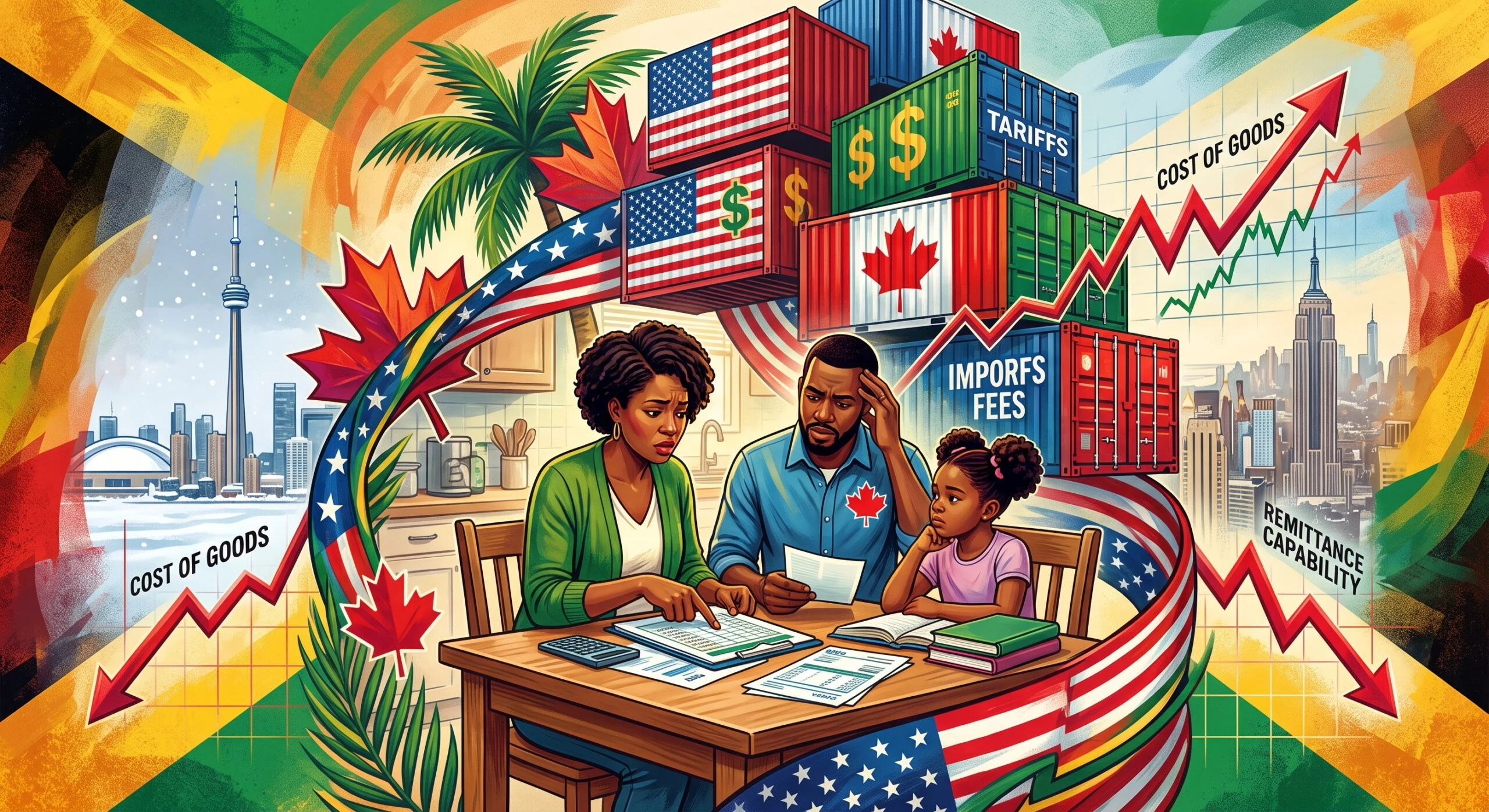
How the 2026 Tariff Shockwaves are Reshaping the Jamaican Diaspora
The Ripple Effect: How the 2026 Tariff Shockwaves are Reshaping the Jamaican Diaspora
The month of August 2026 will undoubtedly be recorded as a watershed moment in North American economic history. Following the breakdown of high-stakes trade negotiations, the United States enacted a devastating 50% tariff on billions of dollars worth of Canadian goods. In swift retaliation, Canada’s Prime Minister Mark Carney implemented a “dollar for dollar” counter-tariff strategy, throwing the two highly integrated trading giants into an unprecedented economic standoff. This clash compounds the sweeping 2025 U.S. trade policies that established a universal 10% baseline tariff on all global imports, including those from the Caribbean.
While mainstream economic analysts are rightfully focused on the macro-level disruptions to the automotive, agricultural, and energy sectors, there is a complex, profoundly human narrative unfolding beneath the headlines. It is the story of the Jamaican diaspora.
Numbering well over two million people spread primarily across the United States and Canada, the Jamaican diaspora is more than a cultural export; it is a vital economic bridge. Diaspora communities in cities like New York, Miami, Toronto, and Brampton are intrinsically linked to the prosperity of their home island. Today, the unfolding trade wars are doing much more than disrupting multinational corporate supply chains they are squeezing diaspora household budgets, threatening the vital lifeline of remittances, elevating the cost of cultural heritage, and forcing a rapid evolution in how Caribbean expatriates invest back home.
Here is an in-depth look at how the new round of tariffs is fundamentally altering the economic reality of the Jamaican diaspora in North America, and the strategic pivots being made to survive it.
The Geopolitical Canvas: Caught in the Crossfire
To understand the impact on the diaspora, one must grasp the sheer scale of the current trade environment. The Trump administration’s invocation of emergency economic powers—specifically leveraging Section 122 of the 1974 Trade Act to address trade imbalances has shattered the predictability of the USMCA (United States-Mexico-Canada Agreement). The new 50% tariffs applied to Canada target core sectors such as electronics, plastics, and forestry. Simultaneously, sweeping tariffs on Chinese imports (up to 20-34%) and standard 10% baseline tariffs on CARICOM nations have fundamentally rewritten the rules of international commerce.
For a Jamaican-Canadian living in Ontario or a Jamaican-American living in Florida, these policies are not abstract governmental disputes; they are immediate taxes on their daily lives. Because the diaspora acts as a financial conduit, any reduction in their domestic purchasing power creates a direct, negative ripple effect across the Caribbean Sea.
The Remittance Squeeze: A Threat to Jamaica’s Lifeline
Remittances from the diaspora are the financial bedrock of the Jamaican economy, traditionally accounting for upwards of 20% of the island’s Gross Domestic Product (GDP). These funds pay for everything from basic groceries and healthcare to school tuition and local business investments. However, the dual shock of the 2025 baseline tariffs and the aggressive August 2026 U.S.-Canada tariff exchange is severely testing the disposable income of expatriate households.
In the United States, tariffs fundamentally act as consumption taxes. As the U.S. levies heavily on imported lumber, electronics, and everyday manufactured goods, the cost of living has surged. A Jamaican-American healthcare worker in New York or a hospitality worker in Miami is suddenly finding that their paycheck doesn’t stretch as far as it did in 2024.
In Canada, the situation is even more precarious. The U.S.’s 50% tariff on Canadian goods threatens major manufacturing and export hubs. For instance, Canada’s electronics and plastics sectors—heavily concentrated in Ontario, home to the largest Jamaican population in the country—stand to lose billions in export value. This leads to profound uncertainty, wage stagnation, and job losses.
Practical Example: Consider a Jamaican-Canadian family living in Brampton, Ontario. The primary earner works in the automotive parts sector, a heavily integrated supply chain now facing massive disruptions. As the factory cuts overtime hours to cope with U.S. tariff barriers, the family’s monthly disposable income shrinks. The $600 CAD they faithfully send back to relatives in St. Andrew, Jamaica, every month is suddenly reduced to $300. Multiplied across hundreds of thousands of households, this micro-level budget cut equates to a massive macroeconomic contraction for Jamaica’s domestic economy.
The Cost of Culture: Importing “A Taste of Home”
The Jamaican diaspora is defined by its fierce cultural retention, which relies heavily on imported goods. From Blue Mountain coffee and Appleton Estate rum to ackee, saltfish, yams, and proprietary spices, these products are essential threads in the cultural fabric of expatriate communities.
The implementation of the 10% reciprocal baseline tariff by the U.S. in 2025 dealt an immediate blow to Caribbean exporters. While Jamaica’s relatively modest trade deficit with the U.S. spared it the crippling 30-50% punitive rates levied on other nations, the 10% blanket tax meant immediate margin compression for Jamaican producers and higher prices for North American consumers.
Practical Example: A popular Jamaican grocery store in Brooklyn or a Caribbean restaurant in Toronto must now absorb the initial 10% tariff on imported Jamaican goods. In Canada, the logistical realities are even worse. Many Caribbean goods transit through U.S. ports before crossing the northern border. With the new 2026 border friction and retaliatory tariffs slowing down logistics, freight costs have skyrocketed.
As a result, a bottle of Jamaican rum, a bulk order of jerk seasoning, or a holiday order of sorrel becomes prohibitively expensive. Business owners are forced to pass these costs onto the diaspora consumer. The emotional and cultural cost is palpable: celebrating holidays, maintaining dietary traditions, and supporting island-based agriculture suddenly carries a hefty geopolitical tax, alienating lower-income expatriates from their cultural staples.
Real Estate and Investments: A Dream Deferred
For decades, the ultimate financial milestone for many in the diaspora has been to purchase land, build a home, or invest in rental real estate back in Jamaica. This capital flight has fueled a construction boom on the island. However, the new tariff regime has complicated this dream significantly, primarily through the disruption of global materials markets and the tightening of foreign investment capital.
According to a June 2026 economic analysis by Jamaica Homes, global tariffs have a profound indirect impact on Jamaica’s real estate sector. The cost of construction in Jamaica relies entirely on imported steel, aluminum, and finished fixtures. With the U.S. and Canada locked in a trade war that includes a strict 25% tariff on steel and aluminum products, the global supply chain for raw metals is heavily distorted, driving up costs for developing nations that import these materials.
Practical Example: A Jamaican-American couple in Atlanta planning to construct a retirement villa in St. Ann finds that the cost of imported steel rebar, roofing, and plumbing fixtures has jumped by 25% to 30%. Concurrently, their own investment portfolio in the U.S. is yielding lower real returns due to tariff-induced domestic inflation and stock market volatility. They are forced to delay the project indefinitely.
This delay has a domino effect: it slows down construction activity on the island, directly affecting local employment for contractors, laborers, and tradesmen. Furthermore, a broader depreciation of the Jamaican dollar against the U.S. dollar—driven by reduced remittance inflows—increases the cost of servicing foreign-denominated debts, straining local developers’ budgets and potentially leading to higher property prices that price out both locals and diaspora investors alike.
Trade Diversion: The Hidden Silver Linings and Opportunities
While the outlook appears grim, global trade disruptions inevitably create market vacuums. This phenomenon, known as trade diversion, occurs when tariffs make traditional trading partners too expensive, forcing buyers to look for alternative suppliers. Resourceful and nimble entrepreneurs within the Jamaican diaspora are uniquely positioned to exploit these gaps.
With the U.S. slapping 50% tariffs on Canadian agricultural and manufactured goods, Canada is aggressively seeking to decouple from U.S. supply chains. This is evidenced by Canada’s recent federal and provincial procurement directives to cancel U.S. contracts and avoid American suppliers where viable.
Practical Example: Canadian grocers and buyers who traditionally sourced specific agricultural products from the American south or Mexico (which also faces high U.S. tariffs) are now desperately looking for alternatives. A Jamaican-Canadian logistics entrepreneur could broker new agricultural supply chains, bringing Jamaican fresh produce, processed foods, or light manufacturing goods into the Canadian market. Because Canadian counter-tariffs are strictly targeted at the U.S., Jamaican goods entering Canada directly could become highly competitive.
Similarly, in the United States, as Chinese goods face astronomical tariffs of up to 54%, there is renewed interest in “nearshoring.” Diaspora members with capital are exploring investments in Jamaican manufacturing or agribusiness, leveraging Jamaica’s geographic proximity to the U.S. and its relatively lower tariff burden (10% compared to China’s rates) to supply North American markets with substitute goods.
Strategic Adaptations for the Diaspora
To navigate this hostile global economy, the diaspora is not sitting idly by. We are witnessing real-time, sophisticated adaptations across personal finance, community organizing, and business strategy:
-
Direct Payments over Cash Remittances: To maximize the value of their shrinking disposable income, diaspora members are increasingly utilizing direct-payment financial technologies. Instead of sending raw cash via traditional remittance houses—which is subject to inflation and fees—expatriates are paying for their family’s utility bills, groceries, and tuition in Jamaica directly through specialized digital platforms.
-
Diaspora Manufacturing and Import Substitution: To bypass the high cost of imported finished goods, diaspora entrepreneurs in North America are shifting their models. Instead of importing finished Jamaican patties or baked goods, they are importing raw, tariff-exempt ingredients (where possible) and manufacturing culturally relevant products domestically in Canada and the U.S.
-
Policy Advocacy and Grant Utilization: Diaspora business owners are mobilizing through chambers of commerce. In Canada, many are leaning on the government’s Regional Tariff Response Initiative (RTRI)—a measure announced to assist small businesses impacted by the U.S. tariffs—to secure financial liquidity and pivot their supply chains away from tariff-heavy routes.
Conclusion
The 2026 tariff landscape is a stark, unforgiving reminder of how deeply interconnected the global economy is. Decisions made in the Oval Office and on Parliament Hill reverberate instantly through the avenues of Kingston, the suburbs of Brampton, and the boroughs of New York. For the Jamaican diaspora, this new round of tariffs represents a multi-front economic challenge: it threatens hard-earned household prosperity, places an exorbitant tax on cultural connections, and puts the brakes on long-term real estate investments back home.
However, the resilience of the Jamaican diaspora is a well-documented historical fact. While the tariffs impose immediate and undeniable hardships, they also rewrite the rules of global trade. By identifying trade diversion opportunities, lobbying for business protections, and strategically adapting their financial support models, the diaspora is positioning itself to weather this storm. Ultimately, the very trade war that threatens their economic stability may serve as the catalyst that positions Jamaica—and its diaspora—as an agile, essential alternative partner in a newly divided North American market.





COMMUNITY DISCUSSION 0
Write CommentBe the first to join the conversation!
What are your thoughts on this story? Drop your perspective, commentary, or insider insight below.