 By canadianyardie
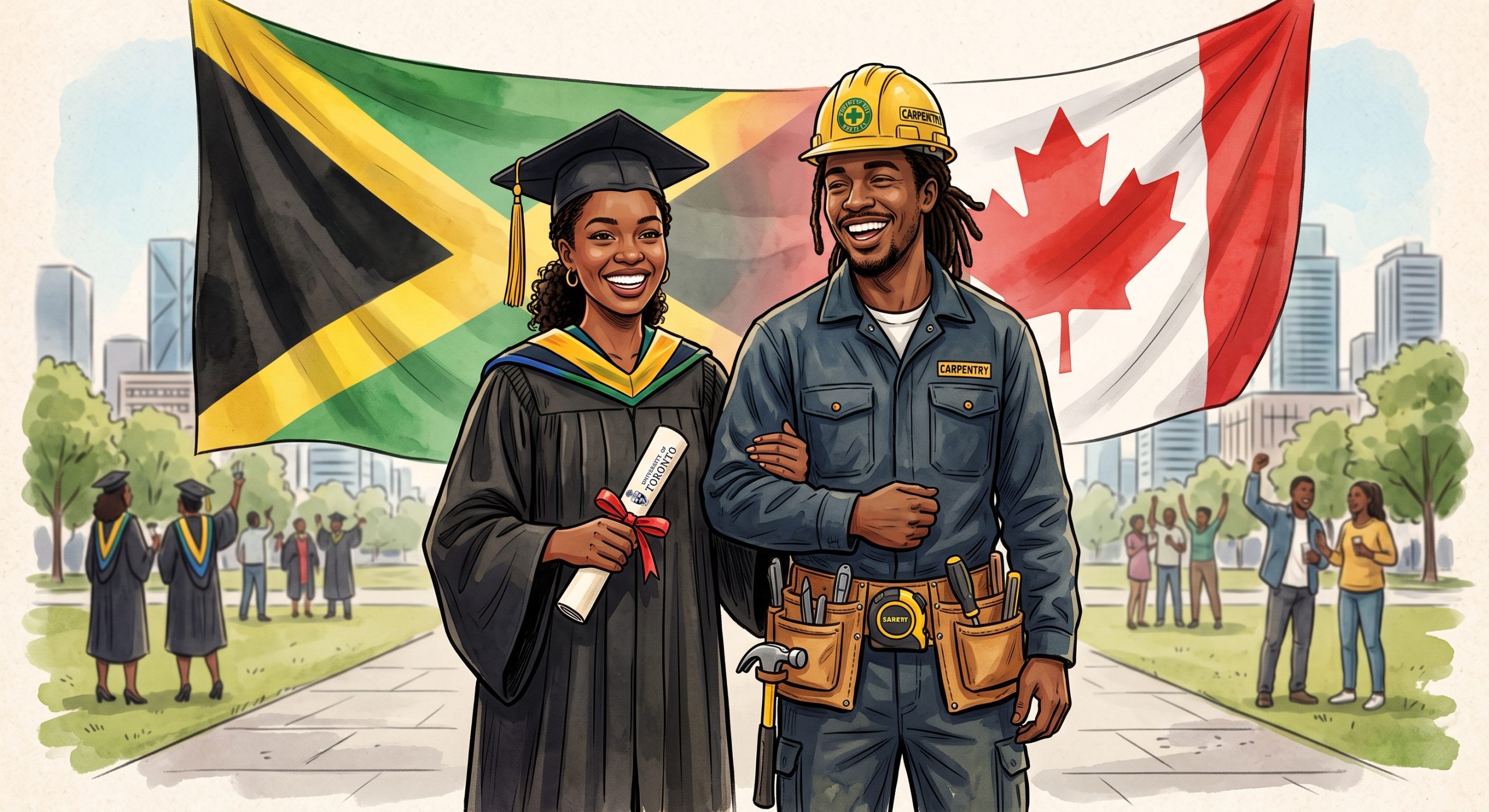
Building Wealth or Chasing Prestige? The Trade versus Degree Argument for the Jamaican Diaspora in Canada
For decades, the Jamaican diaspora in Canada has viewed formal education as the ultimate equalizer. Since the major waves of Caribbean immigration began in the 1960s, Jamaican parents have instilled a singular, powerful directive in their children. That directive is to go to university, get a degree, and secure a professional desk job. This cultural mandate was born out of necessity. For many immigrants facing systemic barriers and racial prejudices in a new country, a university degree was seen as an indisputable proof of competence and the safest shield against economic hardship. However, as the Canadian economic landscape undergoes massive shifts in 2026, a critical debate is emerging within the community. The traditional reverence for the university degree is now clashing with the lucrative, practical reality of the skilled trades.
To understand this debate, one must first look at the cultural weight that the Jamaican community places on higher education. According to data surrounding the 2016 and 2021 Canadian censuses, the Jamaican Canadian population stands well over 309,000. The vast majority of these individuals reside in major urban centers like Toronto and its surrounding Greater Toronto Area. Within these communities, academic achievement is deeply tied to social status. The classic immigrant dream heavily favors titles such as doctor, lawyer, and engineer. Historically, manual labor and trade jobs were often associated with the working class struggles that many immigrants left their home countries to escape. Consequently, a university degree became a symbol of generational progress.
Educational statistics from regional studies provide a snapshot of this trajectory. Data reflecting Jamaican communities in provinces like Quebec indicate that while a significant portion holds high school diplomas, about 25 percent pursue college education and roughly 16 percent attain a university degree. For second and third generation Jamaican Canadians, the push toward university is even stronger. Families often make immense financial sacrifices to ensure their children can attend prestigious Canadian universities. The underlying belief is that a Bachelor of Arts or a Bachelor of Science will automatically guarantee a comfortable middle class life.
Yet, the modern Canadian economy tells a very different story. The financial return on investment for many traditional university degrees has steadily declined. In 2026, the average starting salary for a bachelor’s degree holder sits at approximately $59,000. For graduates holding degrees in fields like humanities, communications, or general business administration, starting salaries can drop to between $45,000 and $52,000. When paired with the soaring cost of living in cities like Toronto, alongside the heavy burden of student loan debt, many young Jamaican Canadian graduates find themselves struggling to build wealth. They are entering the workforce with tens of thousands of dollars in debt and are competing in a saturated job market where a bachelor’s degree is no longer a unique differentiator.
In stark contrast, the skilled trades sector in Canada is experiencing an unprecedented boom. Labor statistics from recent years confirm that skilled trades offer higher earning potential, faster entry into the workforce, and stronger job stability than many traditional four year degree programs. The data is compelling and challenges the long held assumptions about career paths. In 2026, a registered apprentice who completes their training can earn an average of $80,000 per year immediately upon graduation. This figure significantly outperforms the starting wages of most entry level corporate positions.
The ceiling for tradespeople is also remarkably high. Specialized trades command impressive average base salaries across Canada. For instance, plumber steamfitters earn an average of $97,865 annually. Industrial mechanics and millwrights make around $93,584. Industrial electricians take home roughly $88,688, while standard electricians and heavy equipment mechanics routinely clear $80,000. Furthermore, experienced superintendents, estimators, and project managers in the construction industry frequently earn between $120,000 and $180,000 a year.
Perhaps the most striking statistic driving this argument is that 47 percent of skilled trades workers now earn more than the median college graduate. This represents a complete reversal of historical earning trends in North America. For young Jamaican Canadians evaluating their future, the math is undeniable. An individual who enters a trade apprenticeship starts earning an income in their late teens or early twenties. They learn hands on skills while getting paid and they graduate with zero student debt. By the time their university attending peers are graduating and searching for entry level jobs to pay off loans, the tradesperson has already accumulated four years of wealth, work experience, and industry connections.
Despite these clear economic advantages, a stigma against the trades persists within the Jamaican diaspora. Many parents still express disappointment if their child chooses to become an electrician rather than an accountant. This hesitation is rooted in a colonial legacy where physical labor was historically undervalued and exploited. There is a lingering misconception that trade jobs are dirty, dangerous, and lack intellectual rigor. However, modern trades are highly technical. Today, an HVAC technician must understand complex smart building automation technologies, and an industrial electrician must navigate intricate software and sustainable energy systems. These are highly skilled professions that require intense problem solving abilities and continuous learning.
Fortunately, a paradigm shift is slowly taking root among younger Jamaican Canadians. As housing affordability becomes a massive crisis in Canada, the appeal of immediate, high paying, debt free work is overpowering outdated social stigmas. Young people are realizing that financial independence is a much better indicator of success than a framed piece of parchment. Moreover, the trades offer something that aligns perfectly with a core trait of the Jamaican diaspora. That trait is entrepreneurship.
Jamaican culture is famous for its hustle and entrepreneurial spirit. The skilled trades provide a direct pathway to business ownership. A university graduate working in corporate Canada often faces a rigid corporate ladder, office politics, and systemic biases that can stall their advancement. A licensed plumber or electrician, on the other hand, possesses a tangible skill that allows them to start their own company. By acquiring their master license, they can hire a crew, bid on lucrative commercial contracts, and build an independent enterprise. This level of autonomy is incredibly appealing to young Black professionals who want to build generational wealth without being entirely dependent on traditional corporate structures.
Community organizations and leaders within the Jamaican diaspora in Canada are beginning to recognize this shift. Historically, community scholarships and mentorship programs were exclusively geared toward university bound students. Now, there is a growing call to expand these resources to support apprenticeships and vocational training. Advocacy groups are working to rebrand the trades, highlighting successful Black contractors, builders, and tradespeople who have achieved remarkable financial success. By showcasing these role models, the community can help parents understand that supporting a child in the trades is not a concession of defeat, but rather a strategic economic decision.
When comparing the two paths side by side, the argument does not suggest that university degrees are obsolete. Science, technology, engineering, and mathematics degrees still provide excellent returns on investment. Fields like computer science and engineering outpace most trades at the mid career level. The medical and legal professions remain essential and highly respected pillars of the community. The issue is not that the trades beat every single degree path. The reality is that the trades beat the vast majority of general degree paths, particularly the ones that currently dominate university enrollment numbers.
For the Jamaican diaspora, adapting to this reality requires a cultural unlearning. Parents must broaden their definition of success. A child who becomes a licensed heavy equipment mechanic is just as successful, and often more financially secure, than a child who works a mid level administrative job with a sociology degree. True social mobility in 2026 Canada requires financial literacy and practical marketability. The diaspora must prioritize economic stability over superficial prestige.
As the Canadian labor market continues to demand skilled workers to build infrastructure, housing, and green energy projects, the opportunities for tradespeople will only multiply. The Jamaican community is perfectly positioned to take advantage of this economic wave. With a strong work ethic, a natural inclination toward entrepreneurship, and a deep rooted desire for progress, young Jamaican Canadians can dominate the skilled trades sector.
Ultimately, the trade versus degree argument within the Jamaican diaspora is a reflection of a community in transition. It represents the journey from surviving to thriving. By embracing the lucrative reality of the skilled trades, while still valuing targeted, high yield university education, the community can diversify its professional portfolio. Redefining success means celebrating the hardhat and the toolbelt just as proudly as the graduation gown and the diploma. Through this balanced approach, the Jamaican diaspora in Canada can ensure that its next generation is not just highly educated in theory, but financially empowered in practice.





COMMUNITY DISCUSSION 0
Write CommentBe the first to join the conversation!
What are your thoughts on this story? Drop your perspective, commentary, or insider insight below.