
Grandmother says something fast, sharp and funny, and the whole kitchen laughs. You laugh too. You caught every word. Then she turns to you, waiting for an answer, and out of your mouth comes clean, flat Toronto English, like you grew up in a subdivision and nowhere else.
If that is you, you are not broken, and you are definitely not alone. Across the GTA there is a whole generation raised the same way: fluent ears, quiet mouths. We understand Patwa. We just do not speak it.
Fluent Ears, Quiet Mouths
There is actually a pattern to this, and researchers who study Jamaican Canadians have written about it. Children of Jamaican immigrants here tend to aim at Canadian English for school, work and anything formal. Patwa gets passed down anyway, at home, in music, in the culture, until it becomes the sound of being Jamaican, even for people who barely produce a full sentence in it.
And be clear on what Patwa is before we go any further. Jamaican Patwa, or Jamaican Creole, is a language with its own grammar and its own rules. It is not broken English, not slang, and not English spoken badly. Linguists have said this for years. Plenty of our own elders, raised to survive in systems that punished how they sounded, are still catching up to hearing it.
This piece uses Patwa in the title because that is the name the GTA knows best. But the same split lives in Trini, Bajan and Guyanese homes, each with their own speech, their own sayings and their own sound. One experience, many islands. Do not let anybody flatten them into one.
Speak Proper Was A Survival Plan
Before we judge the parents, remember what they were protecting us from.
Plenty of Caribbean parents in Canada made a hard, loving calculation: English, proper and polished, for school and for work, because they had watched doors close on people who sounded too yard. Some were corrected, mocked or passed over themselves. So they corrected us first, at home, before a teacher or a boss could do it crueler.
Kids read the room fast. The home voice stayed in the kitchen, the car and the phone call with family back home. The outside voice handled classrooms, job interviews and friends whose parents came from somewhere else entirely. Nobody held a meeting about it. We just learned which mouth to use in which room, and some of us never learned to switch back on command.
Two Voices Is A Skill
Here is the reframe nobody gave us as kids: code switching is not shame, it is range.
The same person can take a work call in boardroom English, then catch a joke in full Patwa from an uncle, then land somewhere in the middle with their bredrin, all in one afternoon. Toronto itself runs on this mix. The slang of this city carries Caribbean words and Caribbean rhythm into kids with no island background at all, which tells you whose culture has been setting the temperature here for decades.
The problem was never having two voices. The problem is when one of them only ever gets to listen.

The Comeback Is Already On Your Feed
Watch what is happening now, though. The generation that used to lower its voice is posting it.
Skits, music, Carnival season, food content and podcasts have dragged the home languages happily into public. Caribbean Canadian shows like The Moreish Podcast, built by a Toronto raised host with Trinidadian roots, treat our food, history and way of talking as the main event, not the accent in the background. Adults are asking elders to teach them properly. Grandparents who once said speak English are now asking why the grandkids cannot answer them.
Because what goes quiet is not just vocabulary. It is the proverbs that do not survive translation. The prayer voice. The warning voice. The exact line a grandmother uses when she is proud of you, which lands different from any English version of it. Lose the language and you can still love the culture. You just hear some rooms in it through a closed door.
Keep It Alive On Purpose
Practical things, starting this week:
- Answer back, badly if you must. Your accent in it will be Canadian. Speak anyway. Elders would rather hear your rough version than your perfect silence.
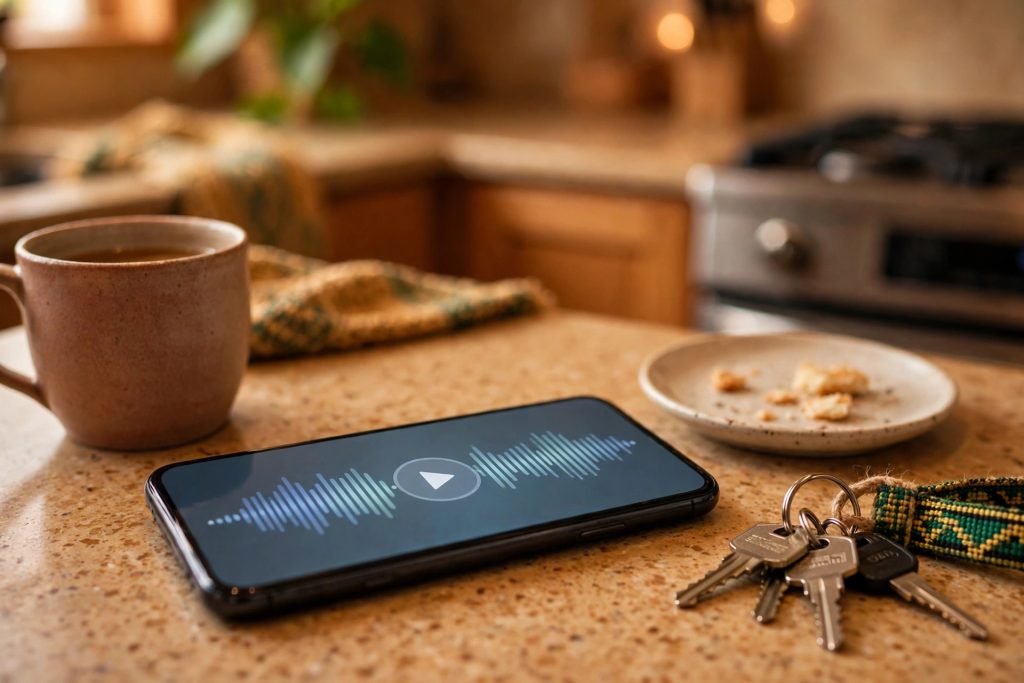
- Save the voice notes. Ask a parent or grandparent to record the stories, the sayings, the prayers. That thread is a family archive and phones get lost.
- Learn one saying a week, properly. What it means, when to use it, when never to use it. Context is the language.
- Call the language by its name. Patwa is a language. So are the Creoles of our other islands. Names teach respect faster than lectures do.
- Let the kids hear it at full volume. Music, family calls, church, Carnival, the kitchen on a Sunday. Children absorb what a house is not embarrassed about.
You do not need flawless Patwa to be Caribbean in Canada. Nobody is handing out passports at the kitchen table. But there is a difference between choosing English and being afraid of your other voice. One of those is range. The other one we inherited, and we are allowed to hand it back.
Sources: Desk research, October 2026. Lars Hinrichs, The Sociolinguistics of Diaspora: Language in the Jamaican Canadian Community (2011), on Patwa transmission to the second generation and Canadian English as the formal code. Published linguistics summaries on Jamaican Creole as a full language with its own grammar. Moreish Podcast details from the CanadianYardie Diaspora Voices shortlist, October 2026. No interviewee is quoted. Experiences described are general research patterns, not claims about any named person.


Get the next ranking first. Join the Yardie Dispatch.



Be the first to comment. Start the conversation!