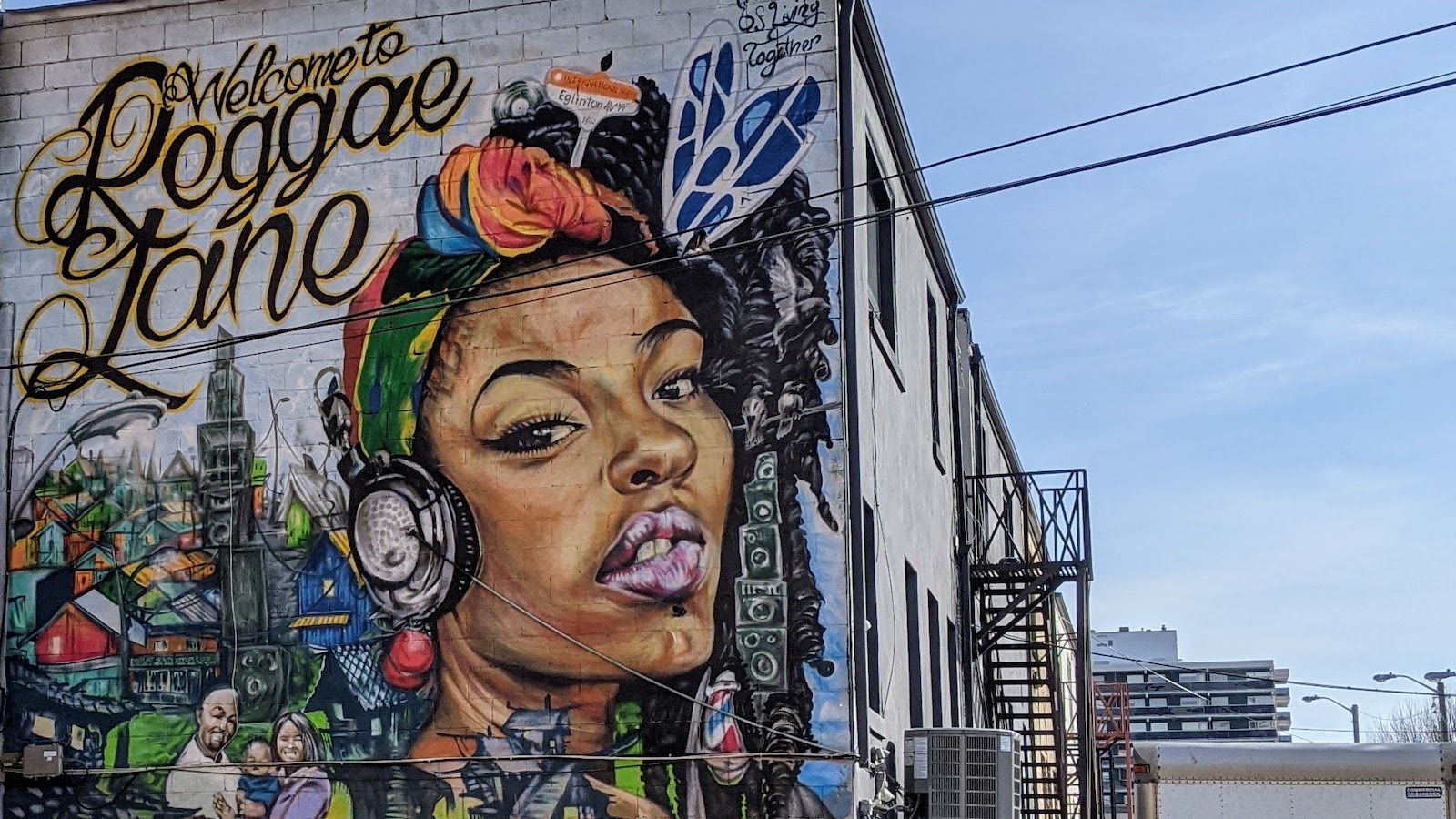
Patwa is not slang here. It is infrastructure, moving through schoolyards, sound systems, hip hop and everyday Toronto speech.
Toronto did not invent this voice
Listen closely on a TTC platform, outside a Scarborough high school or in a late-night group chat and Toronto starts telling on itself. A friend is “reaching.” Somebody has “bare” homework. A plan is “live.” A person asks “ahlie?” and expects agreement, not a dictionary.
These expressions are often bundled under “Toronto slang.” That label is not wrong, but it is incomplete. Much of the city’s verbal swagger carries Jamaican fingerprints. Patwa arrived through migration, family life, churches, barbershops, record stores, sound systems and schoolyards. Then it mixed with Somali, Arabic, South Asian languages, Caribbean varieties and local English. The result is a Toronto voice built through contact.
Patwa is more than a bag of trendy words. It is cultural infrastructure, helping people signal humour, closeness, warning, coolness and belonging.
Why Patwa, not patois?
Both spellings appear in everyday use, so nobody needs a spelling police ticket. Still, this article chooses Patwa for a reason.
“Patois” comes from French and has been used broadly for regional or nonstandard speech. Historically, that label could carry the idea that the language was rustic, lesser or somehow unfinished. “Patwa” writes the word closer to how Jamaicans say it and places Jamaican speech at the centre rather than filtering it through a European spelling.
The Jamaican Language Unit at the University of the West Indies, Mona describes the language as Jamaican, widely referred to as Patwa. It also supports the Cassidy writing system, a consistent phonetic approach designed for writing Jamaican on its own terms. Choosing Patwa, then, is not a claim that everyone who writes “patois” is disrespectful. It is an editorial choice that says the people who speak a language should have authority in naming it.
The short version: Jamaican is the language name favoured in formal language-planning work. Patwa is a Jamaican-centred spelling of the familiar name. Patois remains common, but is a broad French-derived label also applied to other forms of speech.
A language with rules, not broken English
The quickest bad take is that Patwa is broken English. It is not. Linguists generally describe Jamaican as an English-lexified Creole. English supplies much of its vocabulary, while West African languages and the violent history of slavery and colonial contact helped shape its grammar, rhythm, sound and meaning.
Patwa does not randomly drop words. It follows patterns. Verbs do not change exactly as they do in Standard English. Tense and aspect can be marked with particles. Plurals can be expressed with “dem.” Pronouns and sentence structures operate systematically. A fluent speaker is not failing an English test. They are using another grammar.
Calling Patwa lazy speech turns a history of invention and survival into a joke. Enslaved Africans in Jamaica, forced into contact across languages and under English colonial rule, created new ways to communicate. The language carries everything a language must: gossip, grief, prayer, politics, flirtation, comedy and serious thought.
From Jamaica to Jane and Finch
Toronto’s Jamaican population brought more than food, music and flags. Migration grew after Canada changed racially discriminatory immigration rules in the 1960s. Jamaican families established communities across the Greater Toronto Area, with visible cultural roots along Eglinton West, in Scarborough, North York, Rexdale and Brampton.
Language travelled through ordinary life. Children heard one register at home, another from teachers and another among friends. Reggae, dancehall and local hip hop carried Jamaican phrasing beyond Jamaican households. Words moved because people moved, and because youth culture rewards language that is vivid, rhythmic and useful.
Researchers led by University of Toronto linguist Derek Denis call the broader emerging variety Multicultural Toronto English, or MTE. They describe it as a “feature pool,” not a uniform dialect that every young Torontonian speaks the same way. People select sounds, words and grammatical features to build a style. Jamaican Patwa and Somali are major contributors, but the mix belongs to the city’s multilingual reality.
Even pronunciation carries the story. Denis and his colleagues connect the flatter vowel in some Toronto pronunciations of “goat,” closer to “goht,” to Jamaican influence. “Mans” can operate as a first-person pronoun in a sentence such as “mans made it.” The point is not that every viral Toronto phrase came directly from Jamaica. The point is that Jamaican speech helped create the conditions in which a recognizably Toronto repertoire could form.
Code-switching is a flex
Ask many Jamaican Canadian elders how they speak and the answer changes with the room. Patwa may flow at home, at church after service or during a phone call to Jamaica. Standard Canadian English may take over in an office, a classroom or an appointment. Between close friends, the two can dance inside the same sentence.
That movement is called code-switching, although real life is often messier and more fluid than flipping a clean switch. It is not confusion. It is social intelligence. The speaker reads the setting, the relationship and the risk, then chooses the voice that works.
The uncomfortable part is why the risk exists. A white or non-Caribbean influencer can borrow a Jamaican expression and be called funny or cool. A Jamaican child using the same language may be corrected, stereotyped or treated as less intelligent. The sound becomes marketable when separated from the people who carried it.
This is the respectability debate in one scene. Some families pushed children toward “proper English” because they understood the consequences of racism and class judgment. That strategy could open doors, but it could also teach children that the language of intimacy belonged behind closed doors. Respectability was often protection. It was never proof that Patwa lacked value.
Toronto can enjoy the sauce and name the chef
Languages always borrow. Trying to freeze words behind cultural glass would miss how cities work. The problem is not a Filipino, Tamil, Somali or white Torontonian saying a word that came through Jamaican communities. The problem begins when performance replaces relationship, when an accent appears for a camera, or when the origin disappears and Black youth are mocked for the same voice everyone else is monetizing.
Credit is simple. Learn where the language came from. Do not treat Patwa as a comedy filter. Do not assume a handful of words makes you fluent. Notice context, because a phrase can carry different energy in Kingston, Scarborough and TikTok. Most importantly, recognize that “Toronto slang” has authors, routes and memories.
Patwa in the 6ix is a migration story hiding in plain sound. It crossed borders, survived pressure to stay private and helped Toronto name itself. Every “reach,” every “ahlie,” every shift between boardroom English and kitchen-table Patwa holds a small map of the city.
Toronto did not merely copy Jamaica. It listened, remixed and built something local. But the remix hits harder when the original gets its credit.
Sources and further reading: Jamaican Language Unit, UWI Mona; UWI Mona “Writing Jamaican the Jamaican Way”; University of Toronto Multicultural Toronto English research; Government of Canada historical immigration records.


Get the next guide first. Join the Yardie Dispatch.

Be the first to comment. Start the conversation!