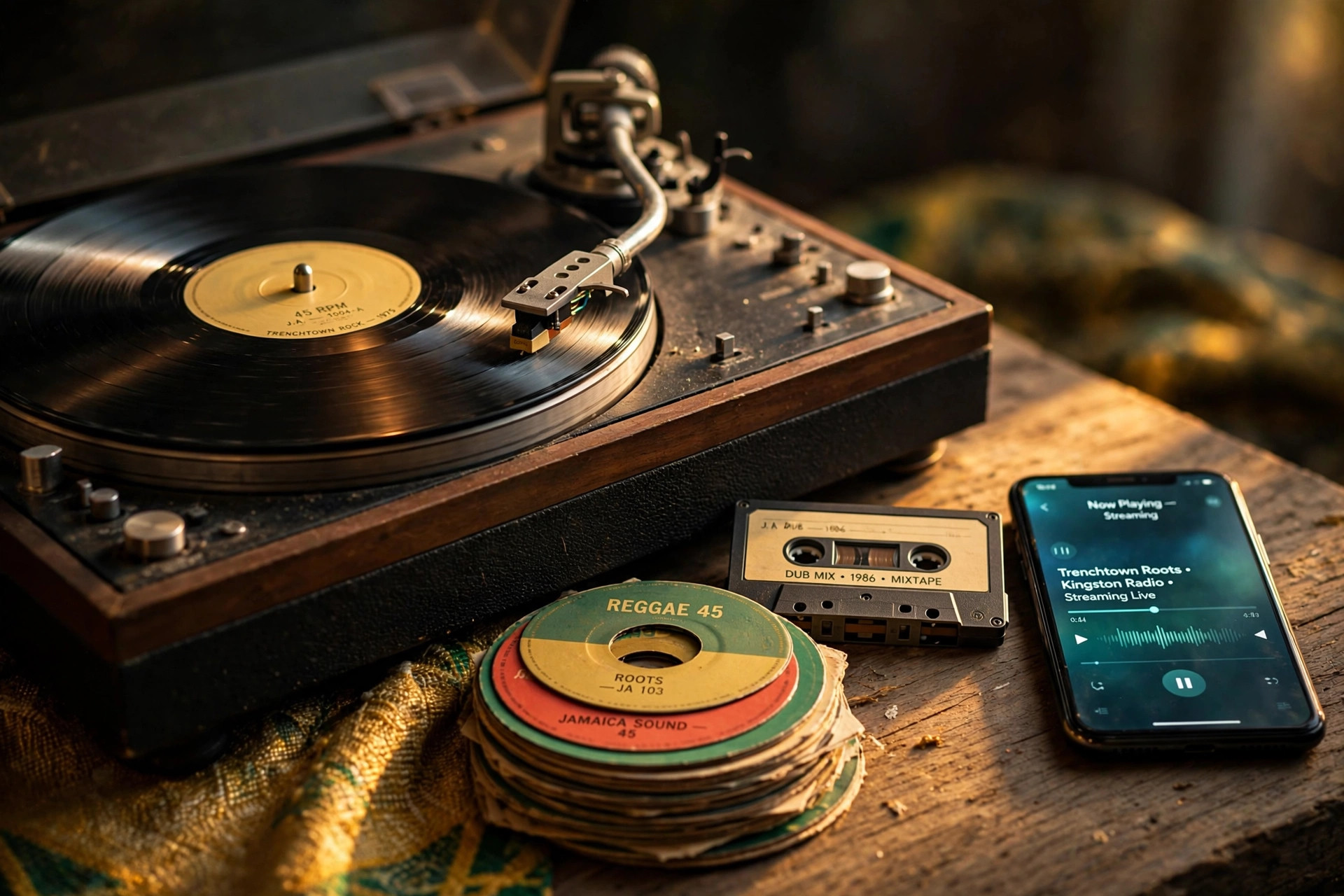
Every era of music has a sound, but for Caribbean people it also has a format. Ask an elder about their favourite tunes and they will not just name the artist, they will tell you how they heard it: on a scratchy 45 at a blues dance, on a dub cassette blaring from a taxi in Half Way Tree, or on a burned CD with the tracklist written in marker. The journey from vinyl to streaming is not just music history for us. It is family history.
The 45 and the Sound System
In Jamaica, vinyl was never just something you played in your living room. It was ammunition. The great sound systems of the 1950s and 60s, names like Coxsone Downbeat and Duke Reid’s Trojan, were built around the 45 rpm single. Selectors guarded their exclusive pressings the way fishermen guard their best spots, because a tune nobody else had could win a sound clash and pack a dance.
Vinyl also gave us one of the greatest Caribbean inventions ever: the dubplate. An acetate pressing cut specially for one sound system, often with the artist calling out the selector’s name. It was the original exclusive drop, decades before anyone said the word exclusive. Studio One and the other Kingston studios turned out 45s by the hundreds, and those little records crossed the Atlantic in suitcases, seeding reggae in London, Toronto, and New York long before the internet existed.
The Cassette Takes Over
By the late 70s and into the 80s, the cassette did to music what the cool box did to refreshments: it made it portable. Boomboxes, Walkmans, and car stereos meant the music moved with the people. In Jamaica, the cassette era belonged to the taxi man and his dub mix, custom compilations recorded off the radio or dubbed from sound system tapes, passed hand to hand like precious documents.
This was also the era when dancehall went digital. When Wayne Smith’s “Under Mi Sleng Teng” rode a preset Casio rhythm in 1985, it proved you did not need a studio full of musicians, and by extension, you did not need much to record at all. Cassettes made distribution cheap. A youth in Trench Town could voice a tune and have it circulating the island on tape within days. The mixtape culture we celebrate today in hip hop? Caribbean sound men were doing the prototype.
The CD Years
The 1990s were dancehall’s global commercial peak, and the CD was the format of that victory lap. Shaggy’s Boombastic, Sean Paul’s Dutty Rock, Beenie Man and Bounty Killer going worldwide, these were CD albums, sold in Sam the Record Man in Toronto and Tower Records in Kingston. The CD also gave us the era of the burned mix CD. Everybody had that friend who “knew a guy” and would show up with a CD-R of the latest Kartel or the hottest soca for Carnival, tracklist scribbled on the disc.
But the CD had a weakness the cassette never did: it was expensive and corporate. The big labels controlled the shelf space. For underground dancehall and bashment, the CD era was glittering at the top but shaky underneath, and that shakiness is exactly why the next disruption hit so hard.
Filesharing Changes Everything
Napster, LimeWire, and later YouTube rips turned music into something you hunted, not something you bought. For Caribbean music, this was a blessing and a heist at the same time. A blessing because a dancehall tune from Kingston could reach a kid in Birmingham or Toronto overnight, no distribution deal required. A heist because the artist often never saw a dollar from it.
Still, this era gave dancehall its second global wave. Movado and Vybz Kartel tunes lived on rips and forum links. YouTube became the unofficial archive of Caribbean music, full of grainy uploads titled “Kartel – Clarks (official audio)” that racked up millions of views. The music escaped the industry’s gates, and in a way it returned to the sound system ethic: the selector, or in this case the uploader, was the distributor.
Streaming and the Algorithm
Today, Caribbean music lives in the stream. Spotify playlists, Apple Music’s dancehall and soca hubs, and TikTok challenges have put songs like “Calm Down” remixes and soca road anthems in front of audiences our grandparents could not have imagined. A 15 second clip can make a tune blow up globally before the artist’s own neighbourhood has heard it. Afrobeats’ rise has even pulled dancehall and soca into new collaborations, blurring the lines between the Caribbean and the continent in the streaming charts.
The upside is reach. The downside is money. Fractions of a penny per stream mean most Caribbean artists still make their real living from shows, dubplates, and appearances, same as it ever was. The format changed; the hustle did not. And there is a new quiet pressure: the algorithm rewards what is already popular, which can flatten the wild regional variety that made Caribbean music so rich in the first place, from chutney soca to bouyon to bashment.
The Vinyl Comeback
Here is the beautiful plot twist. Vinyl, declared dead twice, is back, and Caribbean music is riding the revival. Studio One reissues, Trojan Records box sets, and limited pressings of classic dancehall 45s sell out to a new generation of diggers, including young yardies in Toronto and London who grew up on streaming but fell in love with the ritual: the sleeve art, the needle drop, the crackle.
It is a full circle moment. The 45 that armed the sound systems is now a collector’s treasure. The dubplate that was once a clash weapon is now a prized artifact. We went from vinyl to digital and back to vinyl, and the music never stopped moving.
The Poll
Every Caribbean music fan has an era they swear was the best. Time to settle it. Which one do you miss the most?
- The 45 era: buying singles at the record shop and guarding them like gold
- The sound clash era: dubplates, exclusives, and selector wars
- The cassette era: taxi dub mixes and Walkman days
- The burned CD era: mix CDs with the tracklist in marker
- The LimeWire era: hunting rips and building the ultimate folder
- None of them: streaming is king, and I am not going back
Drop your vote in the comments and tell us the story behind your pick. Because with Caribbean music, the format was never just the format. It was the whole experience.

Hear the next drop before it hits the dance. Join the Yardie Dispatch.



Be the first to comment. Start the conversation!