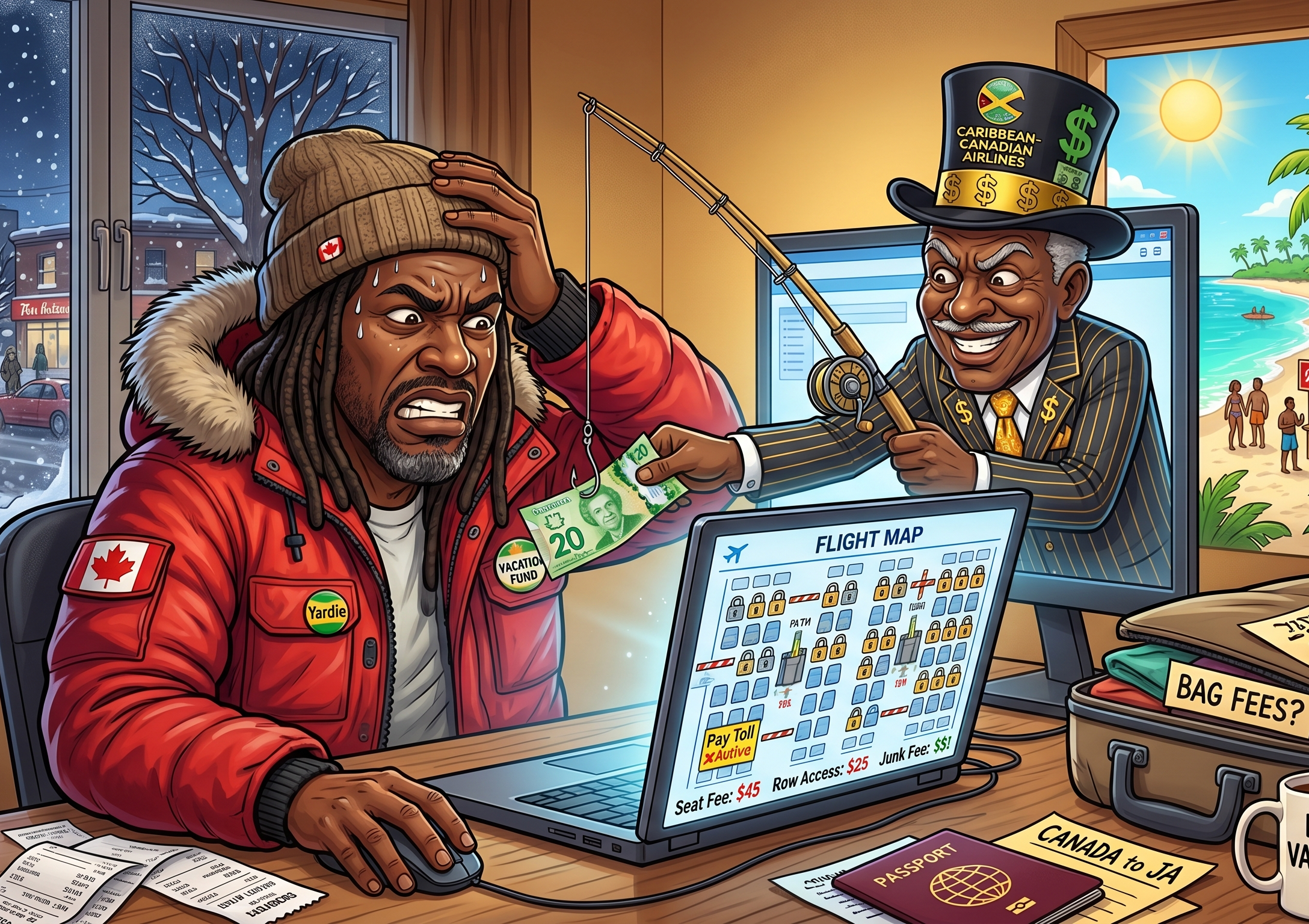

How to Fly to the Rock Without Getting Drip Fed into Debt
So you have finally done it. You have been tracking that flight from Toronto Pearson to Montego Bay for weeks watching the price bounce around like a dancehall dancer on a Saturday night. You finally see a price that makes you do a double take, maybe a sweet $420 round trip. You click Continue faster than you can say Jerk Chicken feeling like you have won the travel lottery.
But hold on. By the time you get through the optional insurance, the extra bag fees, and the mandatory looking seat selection, that $420 flight has mysteriously ballooned into $650. You are left staring at the screen wondering how you went from a bargain to a bankruptcy.
Welcome to the world of Drip Pricing and the Ancillary Fee Gold Rush of 2026. This is not just a flight; it is a high stakes psychological game where the airline is the house and the house always wants a piece of your vacation budget. Here is the massive deep dive into how they get you, why your wallet feels lighter, and how to fight back like a seasoned pro.
1. The Psychology of the Drip: Why You Can Not Say No
Airlines are essentially the toxic exes of the internet. They lure you in with a low base fare to get you into their booking funnel. In the industry this is called Drip Pricing. They advertise the absolute bare minimum price, literally just the cost to put your body in a seat, to appear at the top of search results on sites like Google Flights or Expedia.
Once you have clicked that low price the psychological manipulation begins. You spend ten minutes typing in your passport number, your middle name, your frequent flyer info, and your emergency contact. By the time you reach the seat map you have invested significant time and mental energy.
Psychologists call this the Sunk Cost Fallacy. Your brain tells you, “I have already spent so much time on this booking; I might as well just pay the $35 for the seat so I do not have to start over.” The airline knows that once you are deep in the funnel your resistance to small incremental charges drops significantly.
2. Dark Patterns: The Digital Booby Traps
In 2026 booking sites are designed using Dark UX Patterns. These are user interfaces specifically crafted to trick or nudge you into spending money you did not intend to. On the Toronto to Kingston route these are everywhere.
The Mandatory Illusion: When you reach the seat map the site will often present the paid seats in bright inviting colors while the Skip button is hidden in tiny grey 8 point font at the bottom of the page. Some sites even make it look like you must select a seat to proceed to the next step.
The Fear Factor: You will see warnings like “Seats are filling up fast! 85% of this flight is already booked!” or “Passengers without selected seats may be separated from their party.” This triggers your fight or flight response. You are not paying for a seat; you are paying to avoid the anxiety of being stuck in the middle seat next to the galley.
The Preferred Label Scam: Airlines love to label standard seats as Preferred simply because they are in the front half of the plane. There is no extra legroom, no extra cookies, and no faster exit, just a label that justifies a $45 markup.
3. The AI Shadow: Dynamic Pricing is Watching You
You might think the seat price is fixed but in 2026 it is as fluid as the Caribbean Sea. Airlines now use AI driven dynamic pricing algorithms that adjust seat costs in real time based on you.
The Urgency Tracker: If the algorithm sees you have searched for Toronto to Montego Bay three times in the last hour it knows you are highly likely to buy. It might tweak the seat prices up by $5 or $10 just because it senses your urgency.
The Business Profile: If you are booking a mid week flight the AI assumes you might be a business traveler with a corporate card. Suddenly those aisle seats, the ones business travelers love, cost a premium.
The Party Splitter: One of the most controversial tactics involves the algorithm intentionally leaving gaps between free seats when you book for two or more people. It knows that a couple flying to Jamaica for their honeymoon is terrified of sitting apart so it forces the paid selection to guarantee they stay together.
4. The Child Shield: Your Legal Secret Weapon
If you are traveling with the family the airline will try to scare you with lines like “Family seating is not guaranteed.” Listen close because this part is a legal fact: In Canada the Air Passenger Protection Regulations (APPR) were updated for 2026 to be even stricter. Airlines must facilitate seat assignment for children under 14 in close proximity to a parent or guardian at no additional charge. Here is exactly what the law says you are entitled to:
Under 5 Years: Must be in a seat adjacent (directly next) to the guardian for $0.
Ages 5 to 11: Must be in the same row separated by no more than one seat for $0.
Ages 12 to 13: Must be in a row separated by no more than one row for $0.
If the website tries to charge you $40 to sit next to your 6 year old do not pay it. You can simply skip seat selection. If the airline does not assign you together automatically at check in they are legally required to move other passengers or ask for volunteers at the gate to fix it for free.
5. How to Beat the 2026 Seat Game: The Survival Guide
If you want to keep that seat money for a few extra rounds of Oarsman Rum or a massive lobster lunch at Hellshire follow these battle tested strategies:
The 24:01 Rule
Almost every airline releases its held seats the moment check in opens, exactly 24 hours before the flight. Set an alarm for 24 hours and 1 minute before your flight. Log in immediately. You will often find that those Preferred seats that were $50 yesterday are now suddenly available for free because the airline needs to fill the plane.
Use Incognito Mode and a VPN
Airlines track your IP address and cookies. To avoid Dynamic Pricing hikes always search for your flights in Incognito or Private mode. If you are really tech savvy use a VPN to make it look like you are booking from a different province or country; sometimes the ancillary fees are lower for different markets.
The Middle Seat Gambit
If you are traveling as a duo try booking the window and the aisle in a row of three leaving the middle seat empty. Middle seats are the last to be assigned. If the flight is not 100% full there is a high chance that middle seat stays empty giving you a poor man’s business class for free. If someone does show up for the middle they will be more than happy to trade their middle for your window or aisle so you can sit together.
Checking the Source
Before you pay for a seat check a third party site like SeatGuru or SeatMaestro. Airlines often charge Preferred prices for seats that are right next to the lavatory (smelly and noisy) or seats that do not actually have a window. Do not pay premium prices for a subpar experience.
6. The Economics of the Ancillary Boom
Why are they doing this? Because in 2026 ancillary revenue, fees for bags, seats, and food, is expected to hit a record $165 Billion globally. For many carriers the actual ticket price barely covers the fuel and the pilot’s salary. The profit, the money that keeps the airline in business, comes almost entirely from those drip fees.
For a flight from Canada to Jamaica the competition is fierce. Airlines like Swoop, Flair, and Jetlines have to keep their base fares low to compete with each other. They unbundle the service so they can advertise a $199 fare knowing full well they will make another $150 off you in fees.
7. The Yardie Perspective on Travel Strategy
We are a diaspora that values value. We are the masters of the barrel system, the experts at getting the most out of every dollar, and the champions of stretching a resource until it creates generational change. When we see an airline charging $50 to sit in a seat that costs them nothing extra to provide, our internal Yardie radar should be going off.
We are not just passive consumers. We are active participants in the aviation economy. Every time we refuse to pay a junk fee, every time we leverage the APPR regulations, and every time we use the 24:01 rule to snag a free seat, we are taking back a bit of our vacation power.
There is also the matter of community intelligence. Share your findings. If a specific airline is notorious for splitting families up, let the community know on the forums. If a certain booking site is hiding the skip button, call them out. The airline industry relies on our silence and our panic. By communicating as a diaspora, we can turn the tables.
8. The Golden Rules for 2026 Travel
Do Not Panic: The seat map is designed to make you feel like the plane is disappearing. It is not.
Know Your Rights: If you have kids under 14 the Family Seating fee is a scam. Stand your ground.
Timing is Everything: The best seats are free at the 24 hour check in mark.
Save Your Cash: $50 for a seat is $50 less for your vacation. That is a whole lot of festival and fried fish you are giving up just to sit three rows closer to the exit.
In 2026 a cheap flight to Jamaica is like a cheap patty, if the price is too low you are probably going to pay for it later and it usually involves a whole lot of indigestion. Be smart, stay incognito, and do not let the drip drain your vacation vibes before you even hit the runway.
This story tracks how to fly to the rock without getting drip fed into debt with fresh updates and context for readers.


Be the first to comment. Start the conversation!