
The 2026 World Cup in Toronto Through a Jamaican Lens
The air in Toronto right now is thick. It’s not just the standard, suffocating humidity of a Southern Ontario June; it’s a palpable, vibrating energy. It is Friday, June 12, 2026, and the FIFA World Cup has officially taken over the city. Walk down any street from Scarborough to Etobicoke, and the visual landscape has been completely transformed into a mosaic of international pride. The TTC subway cars look like rolling United Nations assemblies, packed with fans draped in the flags of a dozen different countries, singing chants in languages that blend into a single, unified roar of anticipation. Toronto, long hailed as one of the most multicultural cities on the planet, is finally getting the chance to host the biggest party on earth.
But for Toronto’s massive Jamaican diaspora—a community that has fundamentally shaped the culture, slang, and heartbeat of this city—this historic month is laced with a profound, lingering heartbreak. We are here, we are celebrating, and we are bringing the vibes, but we are doing it without our beloved Reggae Boyz on the pitch.
To understand the specific flavor of the World Cup fever currently gripping the Jamaican community in the GTA, you have to look past the current festivities and cast your mind back just a few short months. You have to understand the agony of March.
The Ghost of Guadalajara
For two years, the dream of 2026 was the animating force behind every football conversation in the community. The expanded 48-team format felt like a golden ticket, a chance to finally replicate the magic of the 1998 World Cup in France, the only time the Jamaican men’s national team had reached the grandest stage. As the Concacaf qualifiers wore on, the Reggae Boyz looked solid, navigating the treacherous waters of regional football and securing a spot in the Intercontinental Play-offs.
The play-off tournament in March 2026 was a gauntlet. When Jamaica edged past New Caledonia 1-0 in the semi-finals on March 26th, you could feel the collective breath of the diaspora hitch. We were exactly one win away. One single victory stood between us and a summer of unprecedented joy on home soil in North America.
Then came March 31, 2026. The play-off final against the Democratic Republic of Congo at the Estadio Akron in Guadalajara.
If you walk into any barbershop on Eglinton Avenue West today, you will still hear hushed, frustrated debriefs of that match. It was a gruelling, tactical, nerve-shredding affair. For 90 minutes, the two teams battered against each other, trading blows but failing to find the back of the net. The tension in living rooms across Brampton, Mississauga, and Toronto was unbearable.
The match bled into extra time. And then, the hammer dropped. Axel Tuanzebe—a player of immense quality—found the breakthrough for DR Congo. A 1-0 victory for the Leopards. The final whistle blew, and DR Congo punched their ticket to the 2026 World Cup.
The devastation was absolute. To come that close, to play 90 minutes of scoreless football with a World Cup berth on the line, only to lose in the dying moments of extra time, is a uniquely cruel kind of sports trauma. It wasn’t just a loss; it was the evaporation of a generational summer. The Reggae Boyz would not be playing in Toronto. They would not be marching out at BMO Field. The dream was deferred once again.
The Pulse of Little Jamaica
Yet, if you think the heartbreak of March has silenced the Jamaican community this June, you fundamentally misunderstand the culture. Jamaicans do not sit out a party, and we certainly do not sit out the World Cup.
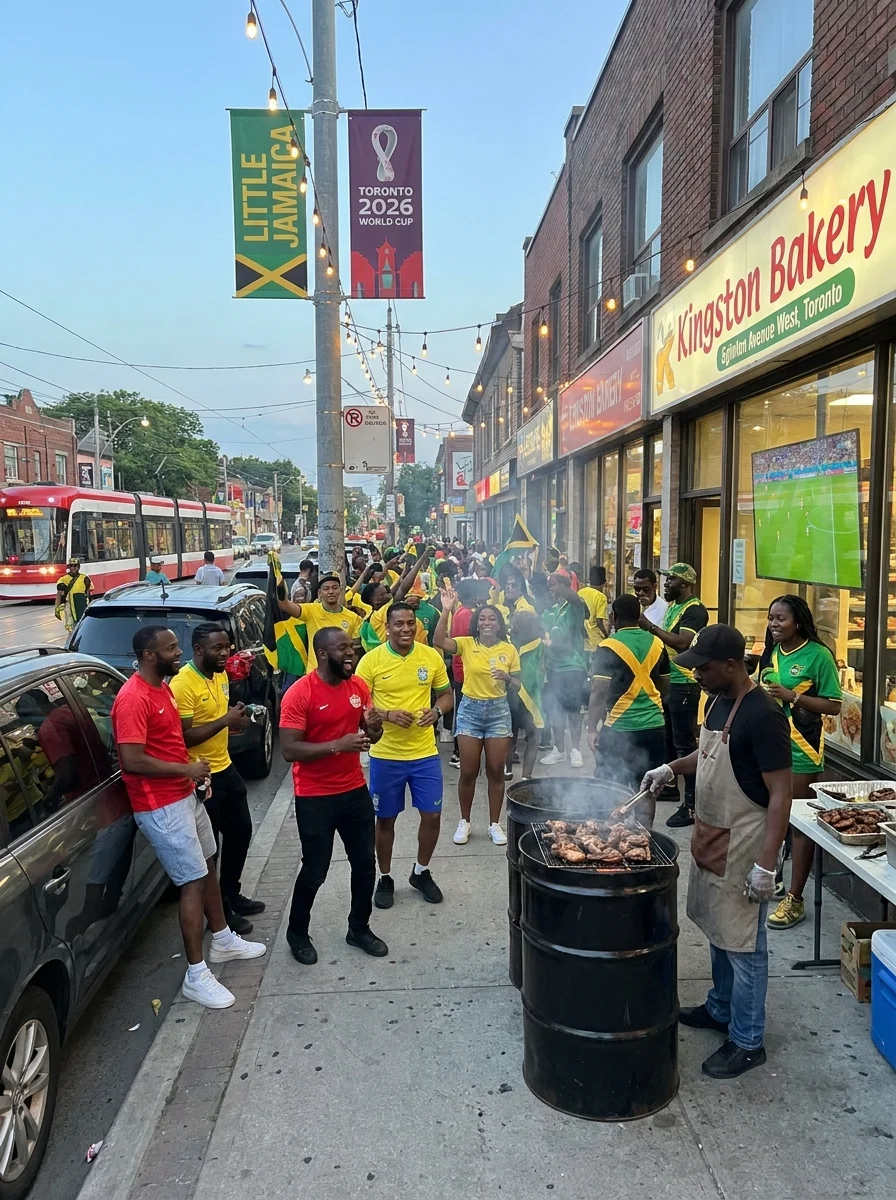
Take a walk down Eglinton Avenue West—the historic artery of Little Jamaica. The flags flying from the windows of passing Honda Civics might not be the black, green, and gold of the homeland, but the energy is undeniably ours. The scent of jerk chicken smoking on oil-drum grills mixes with the exhaust of the city. The basslines of Vybz Kartel, Popcaan, and classic Bob Marley boom from storefront speakers, providing the soundtrack to the tournament.
“We might not be in the tournament, but the tournament is in our city. You can’t have a World Cup in Toronto without the Jamaican massive running the vibes.”
Televisions have been dragged to the front windows of patty shops and local bars. The debates are as loud and fiercely intelligent as ever. Here, football is not just a game; it is a tactical science and a deeply personal religion. Old men in string vests and flat caps argue vehemently about tactical formations, dissecting the modern pressing game and debating whether traditional wingers still have a place in the sport.
There is a bittersweet pride in the air. Yes, the Reggae Boyz fell short, but they fought like lions. They proved they belong in the conversation, pushing a deeply talented DR Congo squad to the absolute brink. That resilience, that refusal to bow down easily, is a point of immense pride. The heartbreak has morphed into a hardened respect for the beautiful game’s unforgiving nature.
The Diaspora’s Dilemma: Choosing a Surrogate Nation
With Jamaica out of the running, the Jamaican diaspora in Toronto is faced with the classic immigrant dilemma: who do we back now? The allegiances are complex, layered, and often fiercely debated within a single household.
1. The Home Soil: Canada
For many, especially the younger generation born and raised in the GTA, the answer is simple: Canada. The Canadian men’s national team is heavily populated by players with Caribbean heritage. When the Canadian boys step onto the pitch at BMO Field, there is a distinct sense of local pride. Rooting for Canada is an acknowledgment of our present and our future. It’s rooting for the city, for the local academies, and for the kids who grew up playing in the parks of Scarborough and Brampton.
2. The Premier League Connection: England
The English Premier League holds a vice-like grip on the footballing imagination of the Caribbean. Walk into any Jamaican bar on a Saturday morning in November, and you will see seas of Arsenal, Chelsea, Manchester United, and Liverpool kits. Because of this deep-rooted weekly investment, and the historical ties, many Jamaicans adopt England as their default World Cup team. When players like Bukayo Saka or Jude Bellingham take the field, they carry the weight of immense Caribbean support.
3. The Ancestral Bond: The African Nations
There is a powerful, undeniable undercurrent of Pan-African solidarity. Even though DR Congo was the team that broke Jamaican hearts in March, there is a strong contingent of the diaspora actively rooting for them, alongside powerhouses like Nigeria and Senegal. It is a recognition of shared ancestry and a desire to see the African continent finally break through and claim football’s ultimate prize.
4. The Beautiful Game Purists: Brazil
And then, of course, there is Brazil. For decades, the sheer flair, joy, and rhythmic beauty of Brazilian football have resonated deeply with Jamaican culture. The ginga—the sway, the swagger, the belief that football should be an expression of art—mirrors the Jamaican approach to life. You will see more yellow and green Brazil jerseys in Little Jamaica than almost anywhere else in the city, worn by older fans who still romanticize the days of Pelé, Ronaldo, and Ronaldinho, and by younger fans mesmerized by Vinícius Júnior.
The Unseen Champions of the Vibe
What makes this World Cup so spectacular in Toronto is the realization that the city’s identity is inextricably linked to its Caribbean community. The tournament organizers, the tourists flying in from Europe and South America, and the media broadcasting the games globally are all stepping into a cultural environment shaped by Jamaicans.
When international fans hit the streets to celebrate a victory, they are likely doing it with a Jamaican patty in one hand, dancing to dancehall music bleeding out of a nearby club. The vernacular of the city—the slang that the world has come to associate with Toronto through artists like Drake—is deeply rooted in Jamaican Patois. The “Toronto World Cup experience” is a Jamaican-influenced experience.
In many ways, the diaspora doesn’t need a team on the pitch to assert its presence. The community is the host. We are the ones providing the hospitality, the flavor, the rhythm, and the unrelenting energy that makes a World Cup feel like a truly global festival. The tailgate parties down by the lakeshore feel like a direct extension of a Kingston street dance. The fusion is seamless.
Looking Ahead to 2030
As the first week of matches kicks off this June, the sting of Guadalajara is beginning to fade, replaced by the sheer spectacle of the sport. Football is a cruel master, but it is also the great healer. Every time a stunning goal is scored, every time an underdog achieves a miraculous upset, the love for the game supersedes the national heartbreak.
The Jamaican perspective on the 2026 World Cup in Toronto is ultimately one of profound gratitude and unyielding optimism. We survived the devastating low of the Intercontinental Play-offs, and we are still here, standing tall, enriching the cultural fabric of one of the greatest sporting events in human history.
The youth watching the matches this month—the young Jamaican-Canadian boys and girls seeing the pinnacle of the sport played in their own backyard—are absorbing an invaluable lesson. They are seeing the standard. They are feeling the atmosphere. The Reggae Boyz may have missed the train for 2026, but the foundation is there. The talent pool in the diaspora is deeper than ever.
As the summer sun sets over the CN Tower and the roar of the stadium echoes across the water, the Jamaican community in Toronto watches, celebrates, and remembers. We revel in the present, but we keep one eye firmly on the future. Because in football, as in life, there is always another cycle, another qualifier, another chance. The world is in Toronto today, but make no mistake: the Reggae Boyz will have their day in the sun again. Until then, we will keep the fires burning, the music loud, and the vibes entirely unmatched.
This story tracks 2026 world with fresh updates and context for readers.



Be the first to comment. Start the conversation!