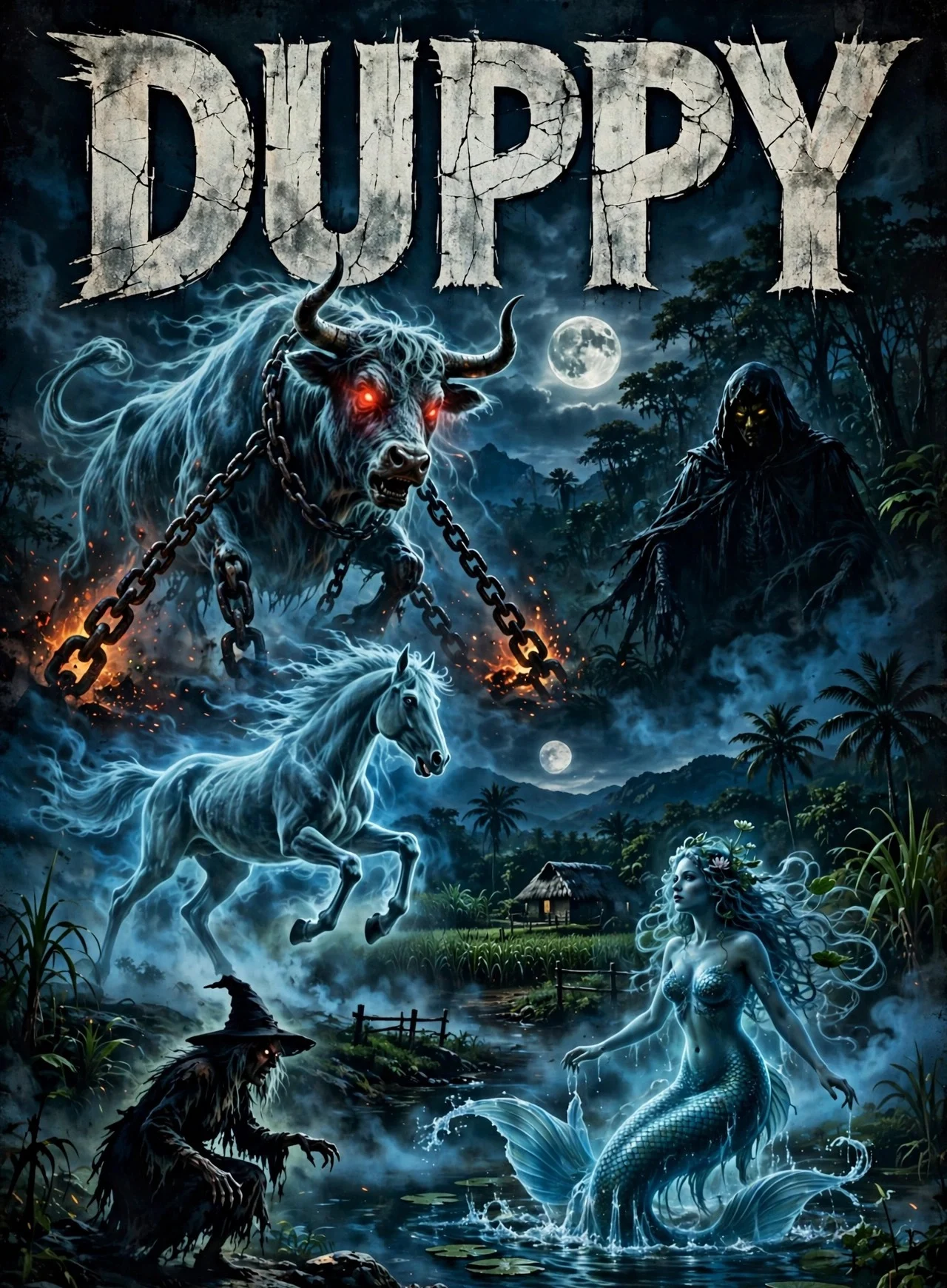
Halloween is days away, and the stores are full of plastic pumpkins and costumes. But here is the thing: Jamaica never needed Halloween. We grew up with something far scarier than a haunted house on Eglinton. We grew up with duppy stories, told by grandmothers who believed every word, on nights when the power went out and the whole district went dark.
If you were raised Jamaican, you know exactly what I am talking about. And if you are raising Jamaican kids in the GTA, this is your heritage horror collection. Gather round.
First, what is a duppy?
A duppy is the spirit of a dead person that has not rested, and in Jamaican belief it is not a friendly ghost. Duppies are souls of the dead that can take different shapes, animal or human, and they mostly come out at night. The word and the concept come from West Africa, carried across the Atlantic and kept alive for centuries.
Jamaicans take duppies seriously enough to build customs around them. Nine-night wakes give the spirit a proper send-off so it does not linger. And there is an old saying every yard kid knows: duppy know who fi frighten. The spirits pick their targets. Which, when you think about it, is exactly what a grandmother wants a misbehaving child to hear.
The silk cotton tree is the most famous duppy address in Jamaica. Big, ancient, impossible to miss, these trees were said to house spirits, and sensible people did not linger under one after dark.
The Rolling Calf
The undisputed heavyweight champion of Jamaican duppy stories. The Rolling Calf is a massive ghostly bull or calf with flaming red eyes, dragging rattling chains as it rolls through country roads at night. Some say it is the spirit of an especially wicked person. Others say it was a butcher in life, doomed to roam in death.
The chains are the part that gets you. On a quiet country night, before you see anything, you hear the clank, clank, clank coming up the road. Miss Lou, Louise Bennett-Coverley herself, wrote a poem about the Rolling Calf, which tells you how deep this one sits in the culture. It is not some obscure legend. It is canon.
The old defence, if you ever meet one: drop salt or rice behind you and run. The duppy has to stop and count every grain. Use the head start wisely.
The Three-Foot Horse
Picture walking home on a lonely road at night and hearing hooves. You turn around and there it is: a horse galloping straight at you on three legs. The Three-Foot Horse is another classic duppy form, less famous than the Rolling Calf but just as terrifying in the telling. Some versions say it is the spirit of someone who died badly, still running the roads they used to travel.
The three-legged detail is what makes it stick in a child’s brain. A normal ghost horse you can rationalize. A horse missing a leg that still outruns you? That lives in your nightmares rent free.
River Mumma
Not every duppy lives on land. River Mumma is Jamaica’s mermaid, a beautiful woman who sits by the river combing her long hair, guarding the water and whatever treasure hides beneath it. She is famous around the Flat Bridge over the Rio Cobre in St. Catherine, a spot built by enslaved Africans in the 1700s that has seen more than its share of tragedy. The poet Lorna Goodison wrote about her too.
The rule with River Mumma is simple: admire from a distance, do not touch, and definitely do not try to take her gold. The ones who tried are still down there, according to the stories. Every Jamaican parish has a river or a spring with its own version of her, and every one of those stories ends with somebody who should have listened.
Old Higue
Then there is Old Higue, the one that kept mothers up at night for real. By day she is an old woman. By night she sheds her skin, turns into a ball of fire, and flies through the dark looking for babies. She is Jamaica’s version of a figure found all across the Caribbean, and she is the reason some households kept rice or salt by the door. Like the Rolling Calf, she has to stop and count the grains, which buys the household time.
Old Higue stories were never just entertainment. They were warnings, stitched into bedtime, about protecting children and watching who comes around the house. The best folklore always has a job to do.
Why we told these stories
Here is the part the think pieces miss. Duppy stories were discipline, entertainment, history, and religion all wrapped into one. “The Rolling Calf will get you” kept kids inside after dark in districts with no streetlights. Anansi stories taught that brains beat brawn. Nine-night traditions taught respect for the dead and care for the living. The stories carried African memory through slavery and colonialism when almost everything else was stripped away.
That is why they still work on us. You can be a grown adult with a mortgage in Brampton, and the sound of chains dragging on an empty road at 2 a.m. will still raise the hair on your neck. Some programming you never uninstall.
Your Halloween assignment
So this Halloween, before you take the kids trick-or-treating around the subdivision, do the Jamaican thing. Turn the lights low, gather everybody close, and tell one duppy story the way your grandmother told it to you. Start with the Rolling Calf. Do the voice. Pause before the chains.
And if the kids get scared, just tell them what every Jamaican child was told: duppy know who fi frighten. Then make sure the doors are locked anyway.
Sources: Global Voices, “The fascinating ghosts and monsters of Jamaica’s folklore” (Oct 31, 2024); Walter Jekyll, Jamaican Song and Story (Project Gutenberg); MacEdward Leach, “Jamaican Duppy Lore,” The Journal of American Folklore (1961).


Get the next ranking first. Join the Yardie Dispatch.



Be the first to comment. Start the conversation!