
The street is quiet by five in winter. Snow is banked along driveways in Brampton or Scarborough, porch lights are on, and inside somebody says, do not answer if you hear your name called outside after dark. The warning still works. Duppy stories do not need the same road or heat. They need darkness, family, and an elder who knows when to lower their voice.
Different islands, different names
These are not all the same story with different spelling. In Jamaica, a duppy is the spirit of a person who has died, and folklorists collecting stories in the 1920s and 1930s recorded duppies that could protect or harm. A bad one could be set on someone through obeah. The nine night gathering gives the spirit a proper send off so it does not linger, and on the ninth night the mattress was turned up to encourage it to leave.
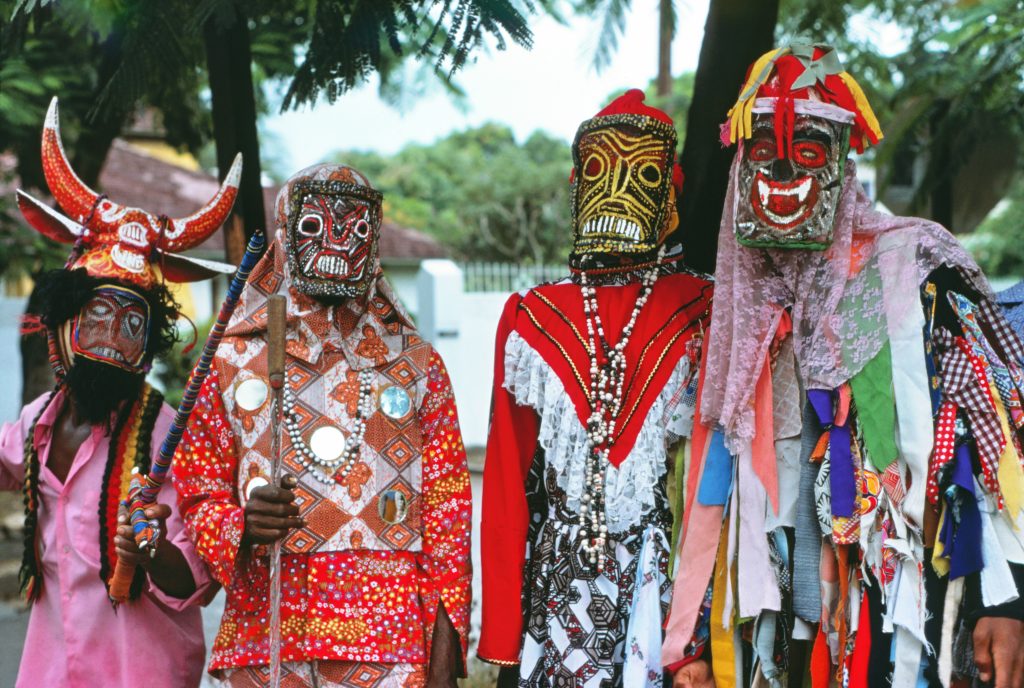
The rolling calf is more specific, and more feared. It is a duppy in animal form, often a large calf or bull with red, fiery eyes, flames from its nostrils and a chain dragging around its neck. Tradition says it is the spirit of a person who was wicked in life, often a butcher or a murderer. It is said to stop and count grains dropped in its path.
In Trinidad and Tobago, the broad word is jumbie, a category for restless spirits of the dead. The soucouyant is distinct. By day she is a reclusive older woman. By night she sheds her skin, leaves it in a mortar, flies as a ball of fire, and enters a house through a crack or keyhole to suck blood while people sleep. To expose her, stories say to heap rice she must gather grain by grain before dawn. Coarse salt in the mortar with her skin is said to stop her.
In Guyana, jumbie is also a broad class, and the blood sucking figure is called ol’ higue, also written ole haig. She is related to the soucouyant, sharing the fireball and the shed skin. The Guyanese telling has its own details. The skin goes in a calabash, babies and children are favourite victims, and one protection is to turn the key as she tries the keyhole. Another version uses hot peppers in the skin instead of salt.
Barbados has its own vocabulary. Reference works list the hag as the Barbadian name for the same skin shedding figure, while the Heartman is a separate Bajan figure, a man in black said to steal hearts, used as a warning to children to come home before dark.
Why the stories were told
Duppy and jumbie stories were never only entertainment. In the oral tradition collected by Martha Warren Beckwith in Jamaica Anansi Stories in 1924 and Black Roadways in 1929, storytelling kept children close to the house after dark, taught respect for the dead, and put a moral shape around unseen danger. Do not walk alone at night. Do not answer every voice. What you do in life follows you.
Grief is in there too. Nine night is not a horror custom. It is a way to sit with loss, feed people, sing, and help the living and the dead move on. A Toronto family holding a nine night in January, with snow at the door, is doing the same work in a different climate.
There is tension with church teaching, and families handle it differently. Many Caribbean households are deeply Christian and also grew up hearing duppy stories at home. For some, the Bible appears inside the stories as protection. For others, pastors have warned against obeah and treating folklore as doctrine. Do not mock what an elder believes.
How they change in Canada
In the GTA, grandparents are often the carriers. Canadian winter helps them. Darkness falls in the afternoon, and a quiet suburban street can feel as isolated as a country road if you are ten.
Halloween gives the stories a second date. In Jamaica, duppy stories were told all year, not only on October 31. The form is changing too. A story that once needed a veranda now moves as a voice note, is retold in a group chat, or is recorded on a phone at the kitchen table so cousins in different cities hear the same version.
Keep the telling alive, properly
Start with permission. Ask an elder if you can record, and accept no without arguing. A phone recorder is enough. Ask where they first heard the story, who told it, and what island, parish or village that version comes from. Ask what name they use, duppy, jumbie, ol’ higue, soucouyant or hag, and do not correct them into a single term. Ask what the story was meant to teach.
Keep the files safe, share them inside the family first, and credit the teller if you share wider. Scary is fine. Cruel is not. These stories carried people through grief, danger and migration. Treated with care, they will keep travelling well.
Sources: Martha Warren Beckwith, Jamaica Anansi Stories (1924) and Black Roadways (1929); Joseph J. Williams, Psychic Phenomena of Jamaica (1934); USC Digital Folklore Archives, Jamaican Duppies; University of Wisconsin Madison Guyana project page on the Ole Higue; encyclopedia entries for Soucouyant, Caribbean folklore and Nine nights, and the Cambridge Dictionary entry for nine night, all checked October 2026. This article is desk research. No interviewee is quoted and no personal anecdote is presented as reporting.

Get the next ranking first. Join the Yardie Dispatch.


Be the first to comment. Start the conversation!